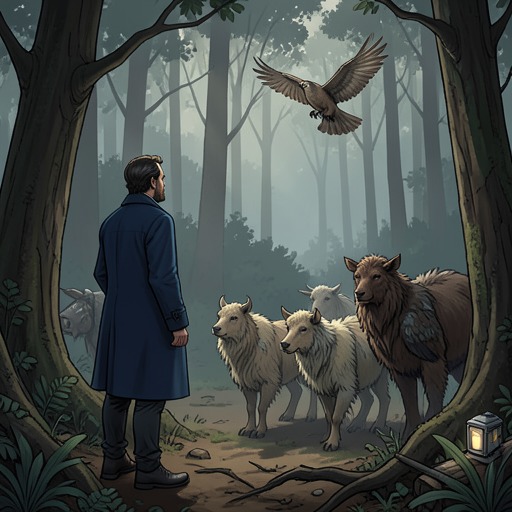
Land otter
The DispossessedThe land otter is a domesticated animal common on Urras, and the first uncaged animal Shevek encounters at close range. Its curious, unafraid approach unsettles the boundary between human and animal: Shevek recognizes it as a fellow being rather than a possession or instrument, and the otter’s easy presence in family life gives that recognition a concrete, recurring form.
Nature and Introduction
Oiie explains that land otters have been domesticated since prehistoric times, initially as fish retrievers and later as pets. Ini’s half-grown otter has short legs, a supple arched back, and glossy dark-brown fur. Its white teeth impress Shevek, who cautiously reaches out to stroke it at Ini’s insistence. The animal sits upright and looks at him with dark eyes flecked with gold, its gaze seeming to cross the gulf between different kinds of life.
The otter is familiar within Urrasti domestic culture, but not to Shevek. Its significance begins in that difference: although it has a history of human use, the scene does not present it simply as a tool. It appears as an alert, curious creature with its own attention, responding to Shevek on terms that are not reducible to its domesticated role.
Encounter with Shevek
After looking at Shevek, the otter drops onto all fours and examines his shoes. Ini reads this interest as affection and tells Shevek that the animal likes him. Shevek replies that he likes the otter, addressing it as a brother. The exchange is small, but it turns an unfamiliar animal into a possible relation: the otter is not merely something to observe, and Shevek’s welcome is not framed as ownership.
The encounter also carries an absent presence. Shevek’s delight in the otter is edged with sadness, as happens when he sees Urras’s animals, birds, or trees. The beauty of these living things is bound to the knowledge that Takver, left behind on Anarres, has never had such direct contact with an animal’s warm fur or the flash of wings in trees. He does not consciously think of her in the moment; instead, the strangeness and beauty of the animal seem to bear a message from her. The otter’s presence therefore joins immediate curiosity to separation and longing.
Domestic Life and Recurrence
The land otter appears again during Shevek’s winter visit to the Oiie household. As Shevek and the boys play in the snow, it repeatedly slides belly-first down a wall of their snow castle. Its exuberant repetition makes it an active participant in the scene, not a decorative pet set apart from the children’s play. The animal shares the garden’s temporary world of tunnels, castles, and snow, moving alongside Shevek and the boys in a game built together.
From the window, Sewa Oiie watches the children, Shevek, and the otter. She calls Shevek their alien, while Vea responds by describing him as the greatest physicist alive and finding the juxtaposition funny. The otter belongs to the household’s ordinary life; Shevek, despite his closeness to the children, remains the visiting stranger. Their shared play briefly draws those positions together without erasing the difference between them.
Significance
The otter’s encounters give animal life a modest but distinct narrative presence. Its gaze, investigation of Shevek’s shoes, and repeated delight in the snow are actions of a creature attending to its surroundings, not just emblems supplied to explain human feeling. At the same time, Shevek’s response reveals how he understands kinship: he recognizes a brother across the boundary of species, and his pleasure carries awareness of the animals and landscapes unavailable to people on Anarres.
The scenes also sharpen the contrast between Urras and Anarres without turning the otter into a simple symbol of either society. It is domesticated and historically used by humans, yet in Shevek’s encounter it exceeds the category of useful property: it approaches, explores, and plays. Through that ordinary, reciprocal contact, the land otter helps make visible a form of relation based on attention and affinity rather than possession.